

3rd Dec 2025
The Story Behind the Tom Morello “Arm The Homeless” Guitar
How a frustrating custom build became one of the most iconic guitars in modern rock.
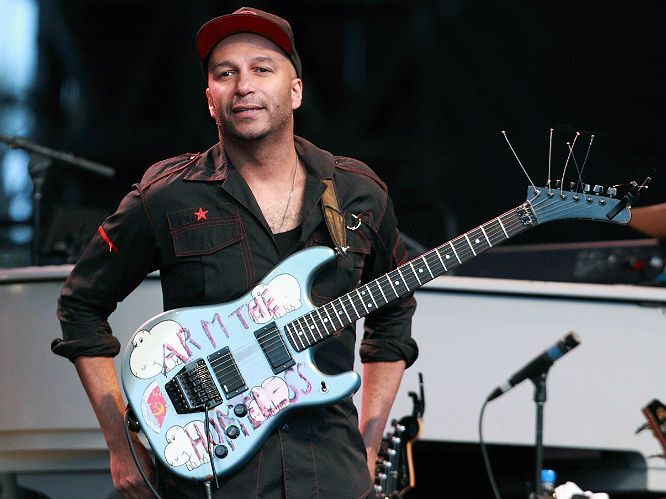
If you’ve ever searched for the phrase “Tom Morello arm the homeless guitar”, you’re definitely not alone. This bright blue, sticker-covered instrument with its bold slogan and smiling hippos has become one of the most recognisable rock guitars on the planet. With its alder body, rosewood fingerboard and hot-rodded hardware, it has inspired countless players and modern recreations in metallic blue finishes.
Buy the Fender Limited edition Tom Morello arm the homeless guitar here.
But the real story behind the Tom Morello “Arm The Homeless” guitar isn’t just about specs. It’s about how a player stopped chasing other people’s tones and turned a flawed custom instrument into a lifelong creative partner.
From High School Band Rooms to a Custom Build
Tom Morello’s musical journey kicked off in Electric Sheep, his high school band in Libertyville, Illinois, where he also played with a young Adam Jones (who later joined Tool). When Morello moved to California in search of bigger opportunities, he decided it was time for a serious guitar that could keep up with his ambitions.
He turned to Performance Guitar USA, run by Kenny Sugai, a builder who had produced instruments for legends like Frank Zappa and Steve Vai. The result was a Strat-style, high-performance guitar, inspired by classic Fender designs:
- C-shaped maple neck with a rosewood fingerboard
- Medium jumbo frets
- Alder body
- Seymour Duncan JB pickups
- Floyd Rose tremolo system
- Pickup selector on the lower horn for fast access
Morello is known for being tough on switches, so Sugai even used an aircraft-grade selector and beefed up the truss rod for extra durability. On paper, it looked like the perfect weapon.
In reality, Morello hated it.
Rebuilding the “Arm The Homeless” Guitar From the Inside Out
Instead of ditching the guitar, Morello went all-in on modifying it. Over the next couple of years, he tore through parts like a mad scientist in a workshop:
- More than a dozen different pickup configurations
- Multiple tremolo systems, including Kahler and various Floyd Rose bridges
- Three or four different necks bolted on and off
By the end of this relentless experiment, the only original piece left on what we now call the Tom Morello Arm The Homeless guitar was its alder body. Everything else had been swapped, upgraded or replaced.
Somewhere in the middle of all that tinkering, Morello had a crucial realisation: no configuration of wood and hardware was going to magically turn him into Randy Rhoads or Nuno Bettencourt. Chasing someone else’s sound was a dead end.
So he flipped the question. Instead of asking, “How can I make this guitar sound like that guy?”, he decided, “Whatever sound this thing makes, I’m going to learn to create with it.”
From Gear Addiction to Creative Limitation
Like many players, Morello had gone through a phase of buying gear in the hope that it would improve his playing. Racks of effects, new pedals, endless upgrades – all in pursuit of the “right” tone.
Eventually he discovered the opposite approach was far more powerful. By embracing limitations and committing to one setup – this quirky, heavily modded, Strat-style blue guitar with a rosewood board – he forced his imagination to do the heavy lifting.
Instead of stacking more gear, he began to explore unconventional techniques:
- Rubbing an Allen key across the strings for metallic squeals and harmonics
- Unplugging the jack and using the cable itself as a noise source
- Using the toggle switch rhythmically, almost like a percussive instrument
This attitude – turning limitations into inspiration – is a huge part of why the Tom Morello “Arm The Homeless” guitar became such an important tool in modern rock. It’s not just about having an alder body or a Floyd Rose; it’s about what you’re willing to try with them.
Modern Specs of the “Arm The Homeless” Guitar
Over the years, the guitar has settled into a now-famous configuration:
- Original alder body
- Floyd Rose-style vibrato system
- Les Paul-style three-way toggle used as a killswitch
- EMG H (single coil in a humbucker housing) in the neck position
- EMG 85 humbucker in the bridge
- Graphite replacement neck – a Kramer-style neck found in a parts bin
Morello achieves his famous killswitch effect by turning one pickup down or off, then rapidly flicking between the active and silent positions on the three-way switch. This simple wiring trick has become a signature part of his sound.
This guitar is his main instrument for anything in standard tuning and has appeared on every record he has made – from Rage Against The Machine and Audioslave to Prophets of Rage and his solo work.
The Slogan, the Hippos and the Attitude
One of the most striking aspects of the Tom Morello “Arm The Homeless” guitar is its look. Morello himself added the famous slogan and the four smiling hippo graphics. As the story goes, he was heading to a show at the Whisky a Go Go and, shortly before soundcheck, he simply scrawled “Arm The Homeless” across the front.
He liked the contrast between a confrontational, political slogan and the almost childlike, playful cartoon hippos all facing the same direction. The bold blue finish, combined with this artwork, helped cement the guitar as an instantly recognisable piece of rock history.
Today, many players love the idea of a metallic blue, rosewood-fingerboard, Floyd-equipped guitar that nods to this legendary instrument – whether through custom builds, mods or factory models with similar specs.
Why the Tom Morello “Arm The Homeless” Guitar Still Inspires Players
In the current guitar world, it’s easier than ever to find instruments with features that echo this legendary axe: alder bodies, locking vibrato bridges, high-output pickups, rosewood fingerboards and bold blue finishes are all widely available.
But the most important lesson from the story of the Tom Morello Arm The Homeless guitar isn’t about copying specs. It’s about what happens when you stop relying on new gear to unlock creativity and instead make a firm decision:
“This is my guitar. This is my rig. The only variable from here is my imagination.”
Morello didn’t fall in love with this guitar because it came out of a shop perfect on day one. He fell in love with it after years of frustration, experimentation and refinement. By pushing its limits – and his own – he turned it into a true collaborator.
So whether you’re drawn to metallic blue, alder-bodied, rosewood-board instruments with locking trems, or any other style, the takeaway is simple: pick a guitar that inspires you, then push it as far as your creativity will allow. The magic isn’t in the name on the headstock; it’s in what you do with it.